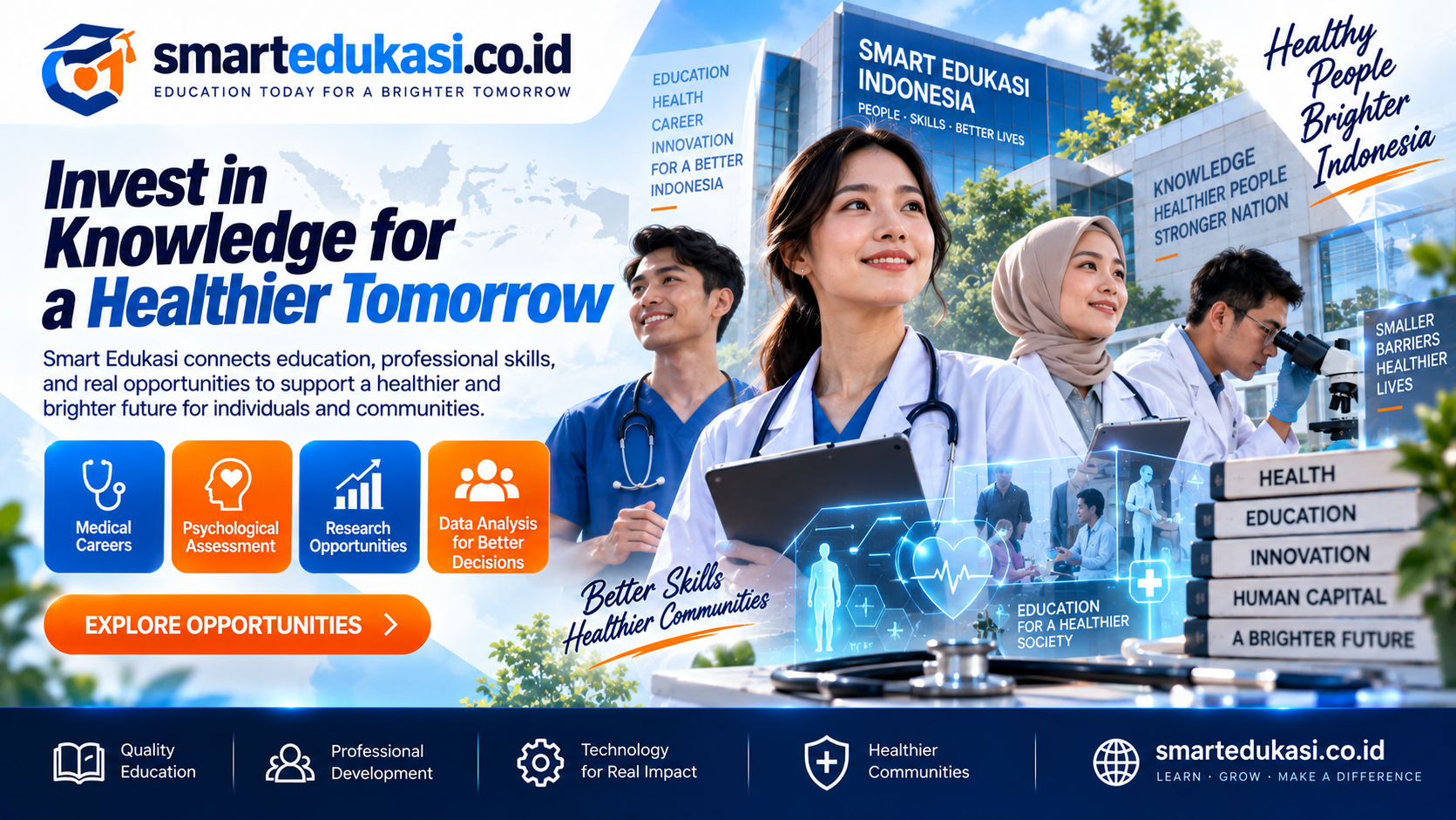
Health is closely connected to education, professional skills, and access to qualified expertise. As healthcare systems continue to evolve, professionals need more than academic knowledge—they also require continuous learning, practical experience, technological awareness, and opportunities to develop their careers.
Smart Edukasi presents an education and career-oriented ecosystem that includes opportunities across several professional fields, including doctors, psychological assessors, researchers, and data analysts.
Education as a Foundation for Better Health
Education plays an important role in building healthier communities. People who have access to reliable knowledge can make better-informed decisions about their well-being, while professionals need specialized education to provide high-quality services.
For healthcare professionals, learning does not stop after graduation. Medical knowledge, technology, research methods, and professional standards continue to develop.
This makes continuous education an important part of professional growth. By connecting education with career development, platforms such as Smart Edukasi can contribute to an environment where knowledge becomes a practical resource for individuals and society.
Smart Edukasi and Healthcare Professionals
One professional category presented by Smart Edukasi is doctors. The website states that opportunities are available for various types of medical specialists, reflecting its broader mission of connecting people with professional and career opportunities.
Healthcare careers require significant preparation and responsibility. Doctors must combine scientific knowledge with communication, analytical thinking, professional ethics, and the ability to respond effectively to different situations.
Creating pathways that help qualified professionals discover suitable career opportunities can therefore support both individual development and the wider healthcare ecosystem.
Mental Health and Psychological Expertise
Health is not limited to physical conditions. Mental and psychological well-being are also important components of a person’s overall quality of life.
Smart Edukasi highlights psychological assessors among its professional areas, describing this expertise as involving psychological examination and reporting.
Psychological expertise can be relevant across many environments, including education, workplaces, professional development, and other settings where qualified assessment is required.
As awareness of mental well-being grows, properly trained professionals can play an increasingly valuable role in helping organizations and communities understand human behavior and psychological needs.
Research Drives Healthcare Innovation
Research is another professional area featured by Smart Edukasi. The platform refers to research opportunities in government and private institutions, including opportunities relevant to science graduates.
Research is fundamental to progress in health and medicine.
New treatments, diagnostic methods, medical technologies, public-health strategies, and preventive approaches depend on systematic research and reliable evidence.
Researchers also help transform scientific questions into knowledge that can eventually improve real-world practices. Developing strong research capabilities is therefore important not only for universities but also for businesses, healthcare organizations, governments, and technology companies.
Data Analysis Is Transforming Healthcare
Modern healthcare generates enormous amounts of information. Hospitals, laboratories, research institutions, clinics, and digital platforms all produce data that can potentially support better decision-making.
Smart Edukasi also identifies data analysis as one of the areas represented on its platform, describing it as the analysis of large amounts of data to support decisions.
In a health context, strong analytical capabilities can help professionals study patterns, evaluate performance, conduct research, and understand complex information.
However, health information is particularly sensitive. Organizations working with such data need appropriate privacy, security, governance, and professional oversight.
Technology and Safety Go Hand in Hand
Smart Edukasi’s activities extend beyond conventional professional development. Its website also introduces technology-focused areas such as the Dynamic Positioning Simulator and Global Maritime Distress and Safety System.
The DP Simulator provides computer-based training that allows maritime crews to practice vessel positioning and emergency scenarios in a controlled environment. GMDSS, meanwhile, is an international satellite- and radio-based maritime communication system designed to improve safety at sea and support distress alerts and search-and-rescue coordination.
Although these technologies are primarily associated with maritime operations rather than clinical healthcare, they demonstrate a broader principle: education and simulation can contribute directly to human safety.
Professional Training Can Reduce Risk
Training is particularly valuable in professions where mistakes can have serious consequences.
Simulation allows professionals to practice difficult situations without exposing people to unnecessary real-world risks. The same principle can be found across aviation, maritime operations, emergency response, engineering, and healthcare.
Technology can therefore complement traditional education by creating environments where professionals repeatedly practice procedures, evaluate decisions, and improve their responses.
The objective is not simply to know more, but to become better prepared when knowledge must be applied.
Healthy Workplaces Need Skilled People
Professional health also includes creating workplaces where people can develop sustainable careers.
Employees who receive appropriate training and clear career opportunities may be better positioned to adapt to changing professional demands. Organizations, meanwhile, benefit when workers possess the skills required to perform their responsibilities effectively.
Smart Edukasi states that one of its objectives is to help young Indonesians identify future career directions and employment opportunities based on their individual abilities.
Connecting skills with appropriate careers can become an important part of long-term workforce development.
Health, Education, and Technology Are Becoming Connected
The boundaries between healthcare, education, and technology are becoming increasingly interconnected.
Doctors rely on digital tools. Researchers analyze large datasets. Psychological professionals use structured assessment methods. Training organizations increasingly incorporate simulations and digital learning environments.
As these fields evolve, multidisciplinary skills become more valuable.
Future professionals may need to understand not only their primary area of expertise but also data, digital systems, communication, research, and responsible technology use.
Smart Edukasi and a Healthier Future
Smart Edukasi demonstrates how professional development can connect education with multiple areas of expertise, including medicine, psychological assessment, research, data analysis, and technology-based training.
The connection between these fields is important. A healthier future depends not only on hospitals and medical treatments, but also on skilled professionals, scientific research, reliable information, effective training, and technologies designed with human safety in mind.
By encouraging people to develop their capabilities and connect those capabilities with meaningful professional opportunities, education can become an important foundation for healthier individuals, stronger organizations, and more resilient communities.